Tuesday, November 28, 2006

Prague Through a Tourist's Eye

I recently visited the City of Prague, also known as “the golden city of spires” on Vltava River. I found Prague very attractive, and the thousand-year history was visible particularly in the architecture. The touristy Old Town, the Prague Castle, the Little Quarter and the Jewish Town made a deep impression on me with beautiful medieval, gothic- and baroque-style churches and renaissance residential buildings, museums, cafes and theaters. One could wander through the meandering streets of Prague for days in a row and continuously discover hidden alleyways and unique views.

The Communist era left a visible mark on the city’s architecture as well, but the historical part has been preserved well and revived. The Museum of Communism is a good place to learn about the terrifying atmosphere and horrors of that era.

A city makes an impression on a first-time visitor through its architectural layout, and people. Particularly people working in the service sector like hotels, restaurants, museums, and shops are the first tourists interact with. Unfortunately, I was not impressed by the Czech tourist service community. Compared to Japan, the Czech service workers did not strike me as very polite or helpful. I wonder if this attitude is manifest only to foreigners or it is rather universal. This is also the case in Moldova and other Central and Eastern European countries. I wonder about the reasons for such attitudes and behavior.

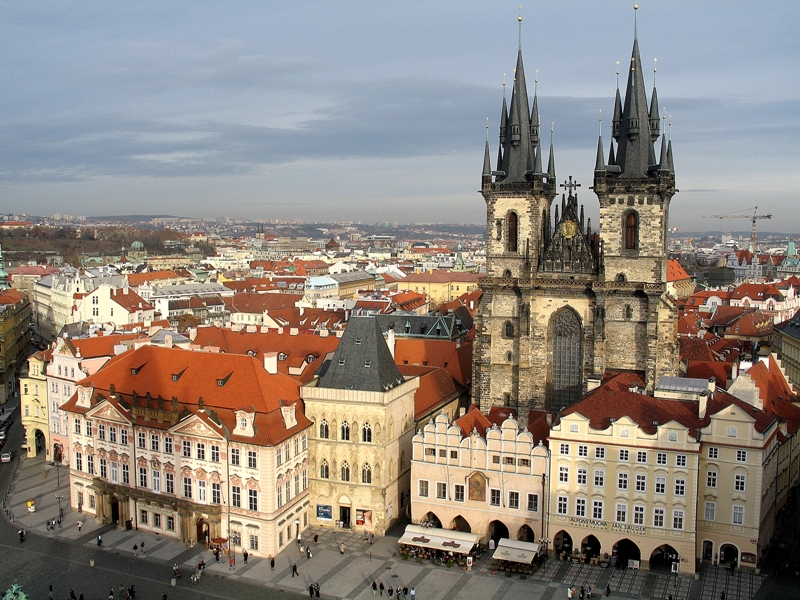
I had wonderful weather in Prague for pictures, so I want to share a couple with you.

Karlov Most and Praha Castle


View of Church of Our Lady before Tyn from Old Town Tower

Vltava River in Sunset

Tuesday, November 21, 2006

Economic Growth Does Not Guarantee a High Level of Human Development

After a successful completion of the course on regional development in Japan, I'm back in Moldova. Today I attended a conference where the publishing of the Moldova National Human Development Report 2006 was announced, and public debate on the findings of this report encouraged. This analytical document was prepared by Moldovan experts and financed by UNDP. My first impression: it is a good analytical piece, and tackles key development issues in the Moldovan economy and emigration, governance and administration, education and health. One achievement of this report is that it attempts to quantify the problems in the sectors that determine the level of human development in Moldova. Another achievement is that it proposes policy recommendations, even very bold ones. Last, public debate is always beneficial, and some very good comments on this topic were made today.

A finding that I find very interesting is that economic growth does not necessarily translate into a high level of human development. What actually matters much more is the quality of economic growth. According to this Report, a high quality economic growth is socially and geographically inclusive. The market alone will not achieve such high quality economic growth. Smart and well-targetted public polices are needed to ensure that all people in the country benefit from it. My sincere wish is that the government consider the findings of this Report in designing future policies.

Wednesday, November 08, 2006

Industrial Clusters: from Finland to Hokkaido to Moldova

Due to rapid changes in the global economy and the phenomenon of the aging society, the Japanese public budget is shrinking, at least in comparison with OECD countries. Today, Hokkaido’s share in the national GDP is 4%, while it absorbs 10% of the national public works budget. A negative outcome of the income-distribution approach is the high level of dependency of the region on central government grants and subsidies. Many professionals, guided by common sense and aware of the macroeconomic trends, question the sustainability of the regional development approach used in Japan, particularly in Hokkaido. They think that it is time for the Hokkaido region to learn to stand on its own feet. So, if the current approach is not sustainable, what is the future of Hokkaido?

Interestingly enough, this question was raised by the academic and business community in Hokkaido, who want their region to become more economically active and competitive both domestically and globally. In their quest for answers and solutions, they went to Finland where they studied the industrial cluster approach. As a result, the NOASTEC Foundation – a public-private partnership – was created in 1998, after a two-year planning effort led by the business people, academics and government officials. Since its establishment, its main task has been to encourage and facilitate cluster formation through provision of valuable information and networks to existing and aspiring entrepreneurs. As of today, NOASTEC’s membership consists of 83 businesses active in three broad industries: food, lifestyle and tourism. The most rapid development (e.g. total sales) occurred in the food industry.

From all economic development practices and policies that I learned about in Japan, this is by far the most suitable, straightforward and promising one for Moldova. There is a wide-spread agreement that three industries have significant economic potential in Moldova: wine-making, textile and informational technologies (IT). In my view, the wine-making should be developed as part of a broader processing food industry to become the basis of Moldovan export. At the same time, the IT industry should receive high priority as the basis for the emerging knowledge industry era. Development of the IT industry will help Moldova secure a niche in the rapidly expanding knowledge-based economy. (By the way, Richard Florida, in his book “The Rise of the Creative Class” identifies technology, talent and tolerance to be the necessary pre-requisites for booming IT-related industries) Finally, after identifying the industries with the greatest economic potential, there is a need for a NOASTEC-like organization which will support the formation and operation of specific clusters throughout the entire territory of Moldova. Hokkaido can offer excellent lessons in food industry clusters, Finland – in mobile communication and medical research clusters, Ireland – in IT clusters, Denmark – in dairy industry clusters. The experience and resources are out there! All we have to do is bring, and apply them creatively in Moldova.

Thursday, November 02, 2006

A Tour through Central Japan

Back from a four-day trip in the central part of Japan, including Osaka, Kyoto, Kobe, Nagoya and Toyota cities. With the Jauntlet (on the left) you can make the same trip, virtually, and see the places I visited, since they say that a picture is worth a thousand words. These destinations were chosen for a particular reason: each embodies one aspect of development efforts in Japan. Osaka is the 2nd largest city in Japan. Kyoto has a priceless historical and cultural heritage, and is one of the most popular tourist attractions. The government approach of preserving and maintaining these beautiful cultural and natural landscapes are worth a praise. Needless to say, I enjoyed wondering through the streets of historic Kyoto the most, although the time was so short. Kobe suffered greatly from a 7.3 degree earthquake in 1995, but the physical traces of this event have been completely removed. It is now a very modern city. The Japanese learned valuable lessons from that experience, and are doing a lot to prepare for future disasters and mitigate their city's vulnerability. Nagoya is the 4th largest city (followed by Sapporo). It is home to the UN Center for Regional Development, and to the world-known Noritake Ceramic Factory. The city, as well as the entire region, promotes industrial tourism. The Noritake Factory and the Toyota Motor Corporation are two sites that we visited, and I personally found such tourism enjoyable, impressive and memorable. If I ever get a chance to buy a car, it will most likely be a Toyota.

Wednesday, October 25, 2006

Japan is Rethinking its Cities

Like many developed countries, Japan faces an important challenge – a rapidly aging society, which is caused by a low birth rate. In fact, Japan’s population is aging the fastest, followed by that of Germany, France, England and USA. In 2005, Japan’s population was about 127 million, and it is expected that in 2050, it will decrease by as much as 50 million, with 65-and-older population representing 35% . Young people postpone marriage, and think twice before having children. Population decrease usually leads to lower economic growth, lower public investment and services, high social assistance and health costs due to a growing number of elderly people, high tax burden on the working citizens, decreasing vitality of local communities, etc. How is Japan’s government approaching this issue? Instead of increasing its reliance on immigration like other developed countries, (Canada, US) Japan is testing alternatives ways of dealing with these demographic changes. In fact, the Japanese central government encourages sub-national governments to design the most appropriate solutions for individual local communities. National and regional development plans are being reviewed so as to adjust to these tendencies. New city planning techniques reflect this reorientation. For example, compact cities aim to control sprawl by concentrating all vital city functions in a clearly defined and well-developed city center. Key features of a compact city are: reduced environmental burden, aggregated city functions in neighborhoods, increased habitability, elimination of traffic congestion, organic transportation systems and improved disaster prevention systems.

Compact cities sound good. We'll have to see how well they work in Japan, and maybe it will be be worthwhile replicating them in other parts of the world.

Friday, October 20, 2006

Understanding Regional Development

Our group had just returned from a field trip in Hokkaido countryside. In the course of four days, we visited Kushiro and Obihiro cities, as well as many other interesting locations and sites. You can find details on this field trip, as well as some pictures on the left, on Jauntlet.

In the evenings, I’ve been reading a very good book on regional development, which I’m happy to have discovered, entitled Regional Development in Third World Countries: Paradigms and Operational Principles. The author, Haruo Nagamine, was a distinguished Japanese development professional and trainer, who attempted to understand and approach the challenge of achieving balanced prosperity and well-being in the developing countries. Although his work and research was focused on South Asian countries, I find his analysis, conclusions and recommendations relevant to current realities in Moldova – a low-income country in transition. Here is Nagamine’s list of constraints that developing countries have to consider (and overcome) in designing and implementing their regional development policies:

Economic constraints
Poverty
Disparity
Stagnant manufacturing industries
Low level of technology
Insufficient employment opportunities
Shortage in basic means of production


Social Constraints
High population growth (not the case in Moldova)
Inadequate provision of basic needs
Inappropriate school curriculum
Inflated material desires


Physical Constraints
Concentration in primate cities
Poor infrastructure
Inadequate maintenance and operation of infrastructure
Deforestation


Constraints in Development Administration and Finance
Ill-defined administrative responsibilities
Inadequate coordination among administrative bodies
Dependence of regional budgets on central governments (in Moldova, it is local governments)
Political system inimical to democratic representation (less applicable to Moldova)
Bottlenecks to community participation
Corruption
Promotion in civil service


General Constraints
Limited availability of information
Vicious cycles of entrenched constraints


Nagamine states that until now – that is in the past five-six decades – regional development policies of South Asian countries have not been very effective, and provides the reasons why. Why has it been so difficult for Japan’s neighboring Third World countries to replicate Japan’s success in regional development, particularly given Japan’s persistent and active mentorship? What can Japan and its ODA recipient government change in their approach of regional development? The lesson for Moldova is that planning and managing regional development should be approached in the most engaged, professional, disciplined, creative, and consistent way. Nagamine expressed this very well:

“Effectiveness of development planning largely depends on the leadership of the government and the willingness of people to act toward a common goal.”

Sunday, October 15, 2006

A Formula for Good Agriculture

This past week, our group learned about agricultural policies and practices in Japan. Five decades ago, the Japanese government decided to make its northern region, Hokkaido, its main food supplier, and since then it has invested heavily in agriculture land improvement through large scale drainage, irrigation and fertility-enhancing projects. Since two thirds of Hokkaido’s 1.2 million hectares of cultivated land originally had a low level of productivity, the current high yield farmland has not come cheaply.

The national agricultural policies are being implemented at the regional and local levels via a network of Land Improvement Districts (LIDs) that manage quite sophisticated agricultural engineering and land conversion projects. Individual farmers who are land-owners are actively involved in LID associations, which ensures the participatory aspect of decision-making in agricultural policies. In fact, the staff of LIDs are ex-farmers. The projects are financed in the following way: 50-66 % - from central government, 17-30% from prefectures, 6-14 % from local government, and individual farmers contribute the remaining 5-15%.

Another component of Japanese agriculture are agricultural cooperatives, managed by agriculture professionals whose major objectives are to support farmers in all possible ways, foster cooperation and consensus among farmers, and promote governmental policies in agriculture. There are about 840 cooperatives in Japan, and around 120 in Hokkaido. Farmers make up the membership of these cooperatives, pay membership fees, participate in the decision-making process, and benefit from a wide range of services such as equipment rental, loans, whole-sale and retail networks, training, consulting, etc. In addition, these cooperatives are active political lobby groups.

In conclusion, the Japanese agricultural model follows a pretty straightforward formula:

Good agriculture = a clear governmental policy based on pre-defined national priorities + adequate financing + a strong and efficient institutional and administrative framework + well-organized, properly supported and politically-represented farmers.

This could be a perfectly applicable formula for agriculture development in Moldova, particularly because in the Soviet times, the first three components had been in use as well. Moreover, it is worth mentioning that Japan also faced the challenge of fragmented land (due to privatization). However, the agricultural cooperatives and LIDs are the solution to that problem, and a means to sustaining competitiveness of Japanese agricultural products.